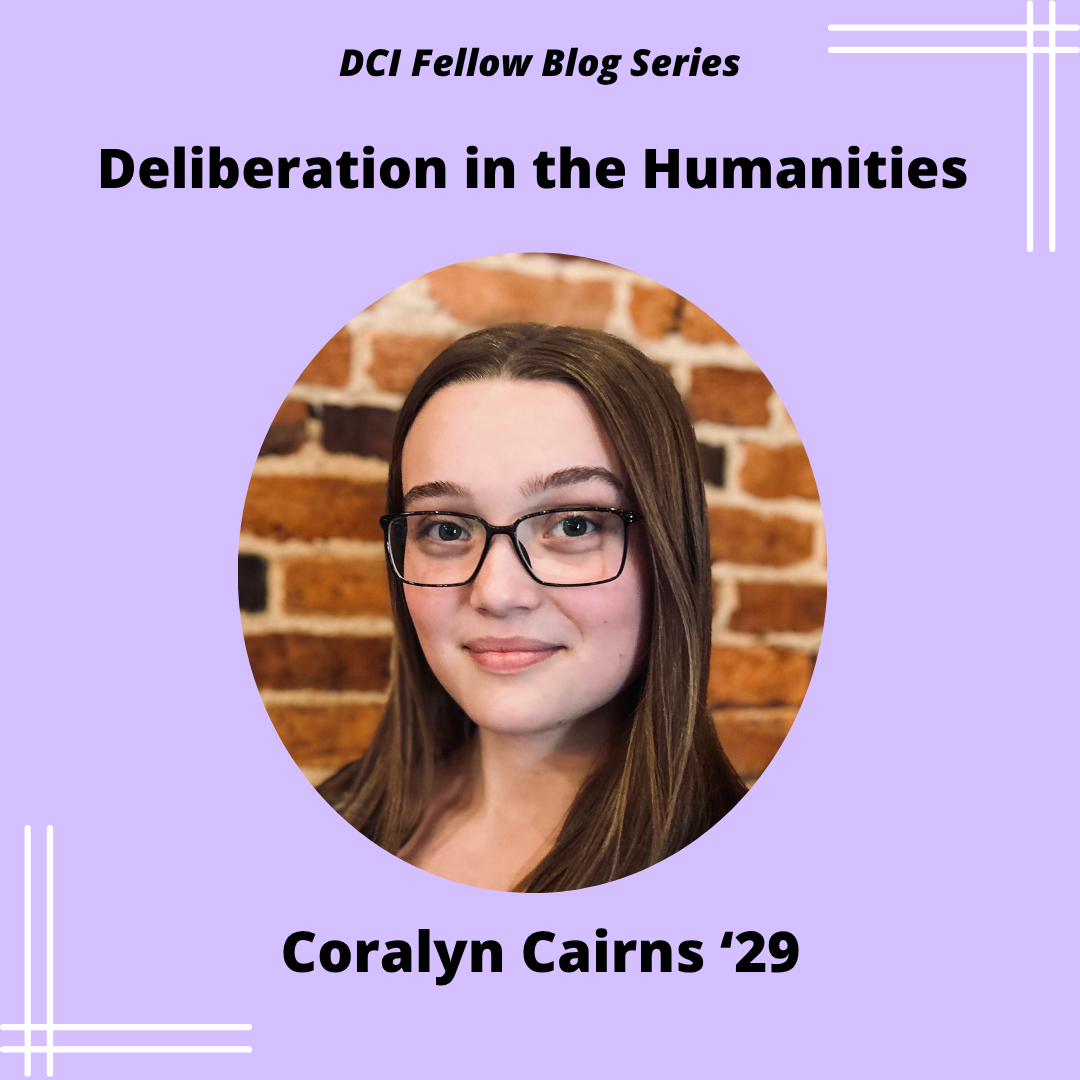
By Coralyn Cairns ’29 (DCI Fellow)
As both a DCI fellow and a “Humester” (the name for students in the Humanities program at Davidson), I have found a lot of overlap between the two settings in terms of deliberation. The Humanities program at Davidson was established in 1962, and while it has evolved over the years since, it nonetheless represents the core values of a liberal arts education—critical, interdisciplinary thought with an emphasis on humane instincts. Although the DCI has had a much shorter tenure at Davidson, it has gained remarkable traction in the larger Davidson community and will now go on to spread deliberative initiatives to 100 colleges and universities over the next four years. I attribute this massive success to the liberal arts environment at Davidson and the interdisciplinary support deliberation receives here. The DCI is not just about changing how we engage in civic conversation. Similarly, the Humanities program is not just about exposure to Humanities fields. Rather, they both center around building dialogues and a mindfulness of how we interact with the world around us.
Before beginning the Humanities program at Davidson (also referred to as Humes if you’re cool), students embark on a pre-orientation trip called Sapere Aude. Sapere Aude is Latin for “dare to know.” You may read this and think the name is a bit cheesy or nerdy, but if I have learned anything in the DCI and Humes, it is that knowing takes bravery. After all,knowing implies a level of thought a bit deeper than simply hearing and believing. Last semester, DCI fellows learned about something called “cognitive hygiene.” This term denotes the action of deliberating and listening to opinions that you disagree with in order to better understand why you support your opinion. Deliberation, in this sense, is like a stone that whets your blade of beliefs. If you know something, it is because you have weighed other possibilities and still come to the conclusion that this something is true. Therefore, knowing requires the strength and bravery to really listen to the opposition. It is not for the light-hearted, yet, I promise, everyone can do it.
The DCI and Humes are not only conceptually grounded in the same principles, but they also are structurally very similar. The DCI held four forums and four rounds of D-teams, or deliberative teams, this year. Participants attend the forums led by expert panelists and then follow-up these forums with their own discussion in D-teams, facilitated by fellows. Similarly, Humes holds two types of classes: plenary and section. During plenary, all students listen to faculty lectures on various topics with some dialogue between students and faculty, but it is mainly led by professors. Section, then, is a smaller group of students with only one faculty member facilitating. This more intimate gathering allows for students to drive dialogue. These parallel structures both foster cognitive hygiene in that participants are exposed to a variety of new ideas, and then they are asked to develop their own opinions in a safe space.
Being a DCI fellow and Humester this year has taught me that learning is not simply about absorbing information; learning is the art of discernment, of teaching yourself how to exist in and contribute to a world that is full of contradictions. Although not discussed in this blog, there are many differences between the programs, yet, at the heart of both is the liberal arts call for thoughtful students who will go on to be deliberative leaders in their communities.