The Deliberative Pedagogy (DeeP) Faculty Collaborative consists of faculty from Davidson College and other higher education institutions who are committed to learning and implementing new ways to improve and deepen the quality of their class discussions. These faculty come from a wide array of disciplines and backgrounds to study and discuss deliberative pedagogy methods, share their ideas and questions with one another, and work to embed deliberation in their classrooms. In this special blog series, members of the Collaborative describe and reflect on their experiences developing and teaching their deliberation-involved courses.
By Kate LeCroy (2024-25 Deliberative Pedagogy Collaborative Faculty Fellow)
This spring, I re-designed my Conservation Biology course at Rhodes College with the hope of improving students’ engagement with each other about big, current problems in conservation biology. Over the course of the semester, students became not just consumers of information, but active contributors to our shared process of inquiry. We did this by embedding structured deliberations into our weekly rhythm, and we transformed Wednesday classes into deliberations where students navigated environmental “wicked problems” together.
The Topics
We explored five main topics this way: the re-introduction of wolves in Colorado, the consequences of honey bee conservation in North Amerca, philosophical and practical questions surrounding zoos, management of invasive species, and trophy hunting. Each of these issues carried ethical tension, tradeoffs, and a diversity of stakeholder perspectives. Students examined scientific literature alongside economic reports, Indigenous perspectives, and public policy analyses. In doing so, they developed both ecological literacy and gained fluency in collective reasoning.
The Structure
Deliberation, as we practiced it, went beyond discussion. It was a structured, collaborative inquiry into disagreement. It required that students engage with uncertainty, interrogate assumptions, and stretch their thinking by listening carefully to others. Each deliberation spanned two weeks. On the first Wednesday, we focused on mapping out the dimensions of a given issue and identifying a range of positions. Students prepared by reading three assigned articles, conducting their own “ground research,” and submitting their interpretations through an issue survey to capture their initial thinking. In class, three student presenters introduced the week’s topic and synthesized what they had learned from a given assigned reading. Student moderators then guided the class through a group activity that involved collaboratively identifying causes, consequences, stakeholders, and tradeoffs of the issue, and ultimately mapping three or more distinct positions that a person could take.
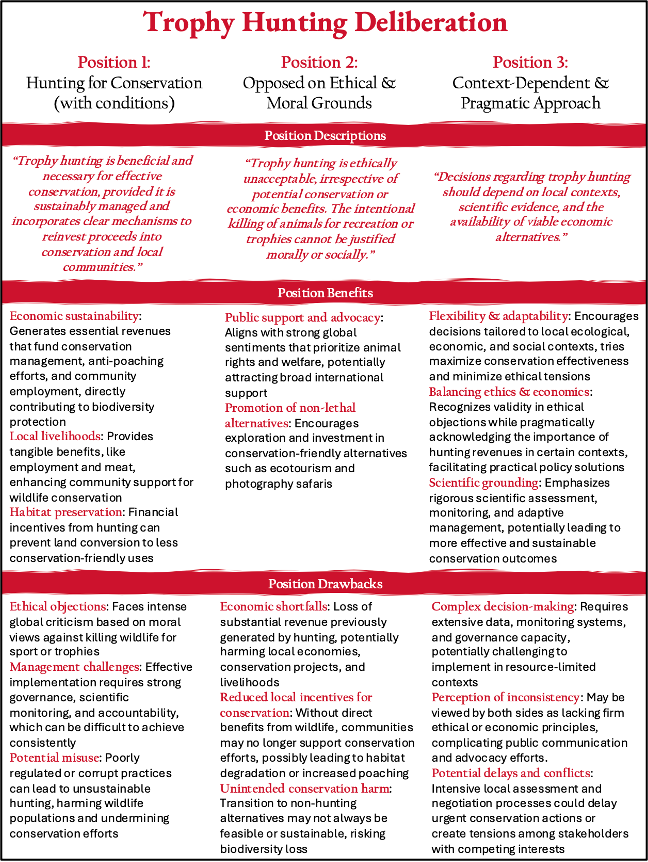
On the second Wednesday of a deliberation sequence, the focus shifted from mapping to actively deliberating. Students signed up to for leadership roles in these second Wednesdays, and each of the 16 students tried at least one of the roles: one student acted as the Opener, summarizing the positions mapped the week before in a graphical handout they designed (example below) along with a brief introduction. Two Deliberation Facilitators then posed questions to the rest of the class, guiding the deliberation process, and a Scribe took notes and captured the conversation in detail, using attribution to help document the deliberation. In the final portion of class, students reflected on how the deliberation impacted their overall takeaway about the issue and broader conservation biology contexts.
Outcomes & Feedback
Student evaluations of their experience confirmed that the deliberative approach deepened their engagement with the material. Many cited the structure, especially the issue forms and leadership roles, as key to their preparation and confidence. They reported that the most engaging topics were those with no easy answers. Trophy hunting, for example, was one of the most popular because it forced students to grapple with competing conservation strategies, moral philosophies, and economic realities. The topic of honey bee conservation surprised many students by upending the assumption that saving honey bees in North America is always a good thing, leading to nuanced discussions about native species and ecological balance.
Several students noted that acting as facilitators, openers, or scribes helped them develop leadership skills and a better grasp of classroom dynamics. They reported growing more comfortable with ambiguity, and as facilitators, they became more confident in drawing quieter voices into the conversation. Disagreement, when it occurred, was overwhelmingly described as respectful and generative. Students recognized that it was not only acceptable, but necessary, to encounter views that differed from their own.
By the end of the semester, students had not only built a strong foundation in conservation biology but had also experienced the kind of civic learning in an upper-level biology course necessary for preparing early-career professionals for a society where misinformation and eroding trust of scientific information is all too common [1]. They learned to navigate complex issues collaboratively, communicate across difference, and listen with the intent to understand. The deliberation format gave them practice in collective reasoning, and the role structure ensured accountability and inclusion.
If the goal of teaching is to help students become more thoughtful, informed, and responsible stewards of the world, then I feel deliberative pedagogy proved itself a worthy foundation. This is a model I plan to keep refining and one I believe could enrich classrooms far beyond mine.
Acknowledgements and References: I would like to thank my first students in the Spring 2024 conservation biology course for inspiring me to learn more about boosting student interactions in class, and I thank the sixteen students enrolled in conservation biology for Spring 2025 for being willing to experiment and try out deliberations. Without their curiosity and willingness to try something new, we wouldn’t have accomplished this work. Lastly, I am deeply grateful to Graham Bullock and the Davidson College Deliberative Citizenship Initiative for their generosity of time, training program resources, and funding. Reference: [1] Osborne, J., & Pimentel, D. (2023). Science education in an age of misinformation. Science Education, 107(3), 553–571. PDF link