The Deliberative Pedagogy (DeeP) Faculty Collaborative consists of faculty from Davidson College and other higher education institutions who are committed to learning and implementing new ways to improve and deepen the quality of their class discussions. These faculty come from a wide array of disciplines and backgrounds to study and discuss deliberative pedagogy methods, share their ideas and questions with one another, and work to embed deliberation in their classrooms. In this special blog series, members of the Collaborative describe and reflect on their experiences developing and teaching their deliberation-involved courses.
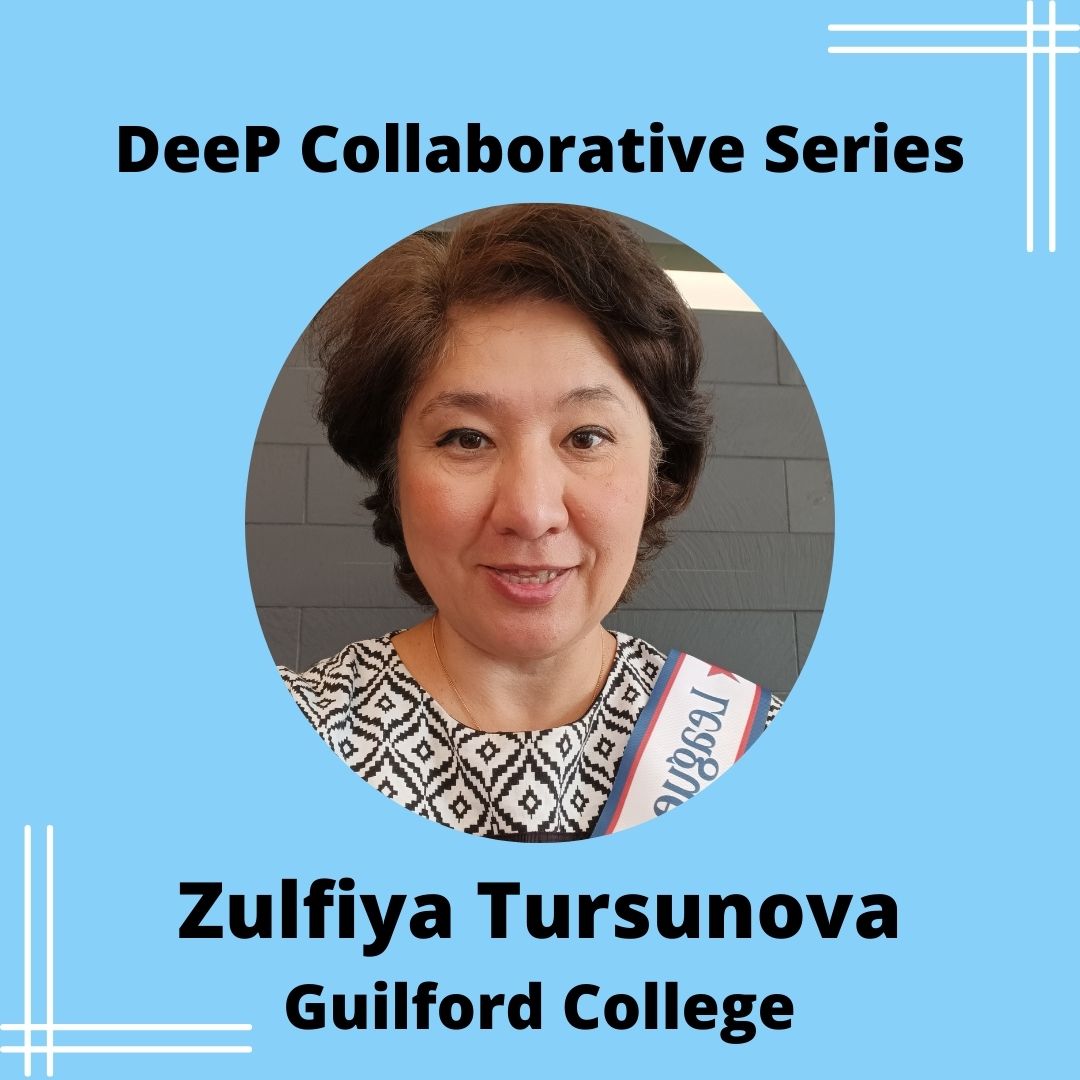
By Zulfiya Tursunova (2023-24 Deliberative Pedagogy Collaborative Faculty Fellow)
During my over 20-year teaching career, I have been rethinking the instructional design of the courses I taught and have made some modifications to create meaningful learning experiences. The training offered by Dr. Graham Bullock and Dr. Sara Copic from Davidson College was critical in integrating deliberation into the PECS 315 Human Rights course that I taught in the spring of 2024 at Guilford College.
One of the PECS 315 course’s main goals was to critically understand human rights by examining how power operates in global politics. The course provides an intellectual framework to understand the complexity of factors and issues related to genocide locally and globally from historical, political, socio-economic, and environmental lenses. We analyzed critical contradictions and connections between rights, law, and peacebuilding. Students examined issues related to citizenship, immigration, deportation, family separation, struggles, and solidarity. The case studies of genocide from the USA, Mexico, Sudan, Israel, Palestine, Columbia, Northern Ireland, China, Russia, and other countries were used to examine atrocities and ways societies move from violence to positive peace.
I introduced the theory and practice of deliberation, differentiating it from debate and discussion, and its role in scholarly inquiry and democratic life in highly divided societies. The values of deliberation and its methodology empowered students to create a safe space where they shared different opinions respectfully. One of the students reflected on the importance of learning about deliberation and engaging with each other during war, global conflicts, and power dynamics:
- “Deliberation allowed us to educate and engage with each other while explaining personal events and experiences related to the world’s power dynamics. As a group, this made our conversations much more personal and powerful. The class allowed us a space to learn about each other while learning about the world and uplifting each other through methods such as conflict transformation on a personal level.“
Deliberative methodology helped to foster ethical peacebuilding and conflict transformation by empowering students to learn and employ deliberative democratic methods of respectful and collaborative problem-solving. The methodology encouraged students to transcend their previously held positions and enabled collective decisions and actions to bring social change and policy for justice and peace. I believe that deliberation theory and practice are congruent with Quaker peace testimonies that nurture the capacities of individuals, communities, and societies to build relationships based on mutual respect and caring for the well-being of all regardless of sexual, religious, and other aspects of our identities. Quakers embrace the transformative power of love and the power of nonviolence, striving for peace in daily interactions with neighbors, families, communities, and people all over the globe.
Five students from various backgrounds took the course. I introduced deliberative pedagogy materials by looking at the issues of immigration using the example Graham Bullock shared with me. Using the talking circle process approach, students shared what they learned in a circle and reflected critically on their learning using human rights justice lenses. One of the students pointed out that “the deliberation was a unique learning experience that now as an academic scholar I can reflect on as one that aided both research skills and facilitation. The overall process of preparing for the deliberation was effective in understanding and being prepared for the actual facilitation.“
One of the students, who deliberated on “International Humanitarian Law: A Focus on Palestinian Women and Children,” shared that deliberation “allowed me to look at human rights from a political perspective rather than just a personal perspective.” Another student indicated that they improved their ability to “evaluate the strengths and weaknesses of different types of evidence.” Through the lens of deliberative pedagogy, students reflected on their learning outcomes focusing on collaboration, reason-giving, synthesis of ideas and information, understanding of trade-offs and tensions, reflection, awareness of relationships, and empathy. It is evident from the students’ answers that the class provided robust opportunities for reflection on the process and outcomes of class deliberations.
The course enabled students to assess and synthesize human rights violations by using international law, policies, and peacebuilding strategies. Furthermore, students learned and cultivated deliberation-related skills including the practical skills of deliberation, self-reflection, empathetic listening, critical thinking, and intellectual collaboration across differences. They also learned about peace and conflict, interdisciplinary analysis and argument using natural resource management, feminist, and political science lenses, as well as communication in both spoken and written forms. This is evident in of the student’s testimony:
- “Overall, I think the deliberation process was unique and especially valuable to the learning and development for students at Guilford. I would absolutely recommend this process to be applied in other classes as well because it truly is a combination of both research skills and facilitation which is so important to have as for any future career opportunities. Not only that it is a good experience to have continued to bring light to the issues we face globally and being able to open up to local and global communities and have necessary conversations that we usually shy away from and ones that have become so polarized.“
In support of innovative, student-centered learning guided by Quaker testimonies, I have been striving to create an academic environment that fosters creative problem-solving skills and civic engagement to promote positive change. As a class, we worked collaboratively on deliberation to promote respect and accountability for human rights among Guilford College students and the community.
Acknowledgments
The special acknowledgment goes to Dr. Graham Bullock and Dr. Sara Copic from Davidson College for sharing their knowledge about deliberation and dedication to their profession.