The Deliberative Pedagogy (DeeP) Faculty Collaborative consists of faculty from Davidson College and other higher education institutions who are committed to learning and implementing new ways to improve and deepen the quality of their class discussions. These faculty come from a wide array of disciplines and backgrounds to study and discuss deliberative pedagogy methods, share their ideas and questions with one another, and work to embed deliberation in their classrooms. In this special blog series, members of the Collaborative describe and reflect on their experiences developing and teaching their deliberation-involved courses.
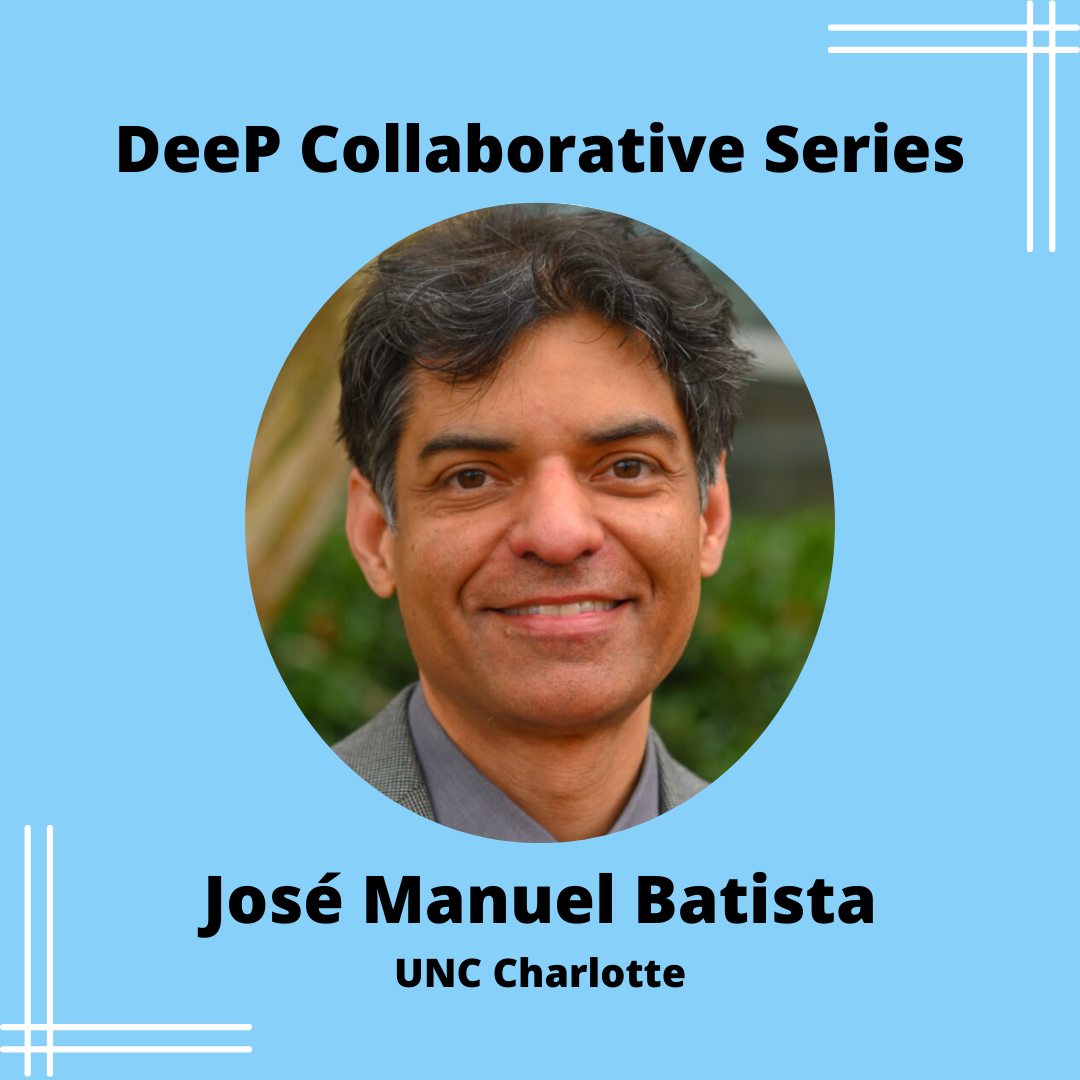
By José Manuel Batista (2024-25 Deliberative Pedagogy Collaborative Faculty Fellow)
Before the first Deliberative Pedagogy (DeeP) meeting, I wanted to get a better idea of what deliberative pedagogy was all about; so, I read through all the DCI Blogs and found the reports from college professors very instructive. Even though I was not versed in the practice or theory of deliberative pedagogy, the DCI blogs did provide a helpful window into what the DeeP collaborators actually did and what would be expected of participants.
Of all the blogs, I found the work of one professor, the classics historian Dr. Vander Poppen from Rollins College, most intriguing and relatable in terms of how I could use a deliberative approach in my course on “Spanish American Civilization and Culture.” After watching his video, I began to think about adopting role-playing to motivate students to engage with historical events, controversies and documents by drawing up a list of major controversies and historical events to consider for the course.
As I came to fully understand deliberative pedagogy under Dr. Graham Bullock’s direction, and its connection with our democratic ideals as documented by Carcasson, Drury, Hess and McAvoy, and others, I realized that I had to radically transform the course and not just add an extended role-play activity to deepen comprehension of the material. I had to embrace a more humanistic pedagogy that fosters empathy and understanding, and not just critical thinking; a pedagogy that revolves around collaborative learning. The epiphany was important because, for this project, I was able to set aside my fixation on inquiry-based learning and the Socratic method.
The readings, different types of meetings, and the participants were instrumental in the process of developing the course. After reading the “DCI Guide to Different Forms of Discourse,” for example, I decided to include at least one of each type of discourse (conversation, discussion, dialogue, debate, and deliberation) so that students could gain a better understanding of a deliberation by way of contrast.
The initial Deliberation Facilitator Training Program Sessions in which DeeP faculty interacted with Davidson Wildcats was one of the highlights of the entire experience. Dr. Graham Bullock and Willow Paul organized micro-deliberations as well as mini deliberations for us to experience. I personally found these events memorable and meaningful. For example, I decided to use micro-deliberations as a skills development tool from this experience. In this manner, I thought, I could dedicate a particular warm-up session to a basic aspect of deliberation whether its deliberative dispositions, facilitation styles, ground rules, etc.
The DeeP Collaborative Cohort meetings were also helpful. In the second such meeting, I remember the biologist Dr. Kate LeCroy sharing her course plans and I was struck by her emphasis on the debrief and reflective component of the deliberations. Up until then, I had not really considered the value of the debrief or reflection, and, as a result, I made sure to leave ample room for this important step of the deliberation. More importantly, she really seemed to grasp the humanistic element of the deliberation; something that I had not yet fully assimilated.
The Faculty Partner Meetings were also great; I was fortunate to be paired with Dr. Abril Jiménez, a professor of Spanish at Davidison College. As language professors, our discussions helped me better adapt the deliberative approach to my Spanish language content course. Dr. Jiménez also showed me the value of broaching current affairs topics in class. In fact, we now share an ever-growing discipline-specific list of deliberation topics to use in our Spanish-language classroom. As a side note, we may be the first DeeP partners to conduct all of our meetings in a foreign language!
The course I worked on is titled, “Spanish American Civilization and Culture: A Deliberative Approach,” and it’s an advanced undergraduate Spanish level content course. The first two weeks we read a selection from Grant and the first three chapters from Aikens and Talisse. Student wrote brief summaries of the reading assignments. They also thoroughly enjoyed the discussions and found Grant, in particular, incredibly helpful in their own personal lives.
Initially, students were to complete a dozen or more micro-deliberations as a class warm-up. Instead, however, since the aim was to use the micro-deliberation for skills development, the activity ended-up taking nearly the entire 75-minute class session. As a consequence, the number of micro-deliberations were reduced from 15 to five.
Students found these sessions helpful in terms of understanding what deliberations entail, practicing the deliberative rules or dispositions, and, most importantly, managing their emotional response to contrary views. All deliberation topics were contentious current affair topics and given the diversity of the classroom (36% white, 36% latino,18% African American, and 9% Asian) the deliberations were lively and, for some, challenging.
Dr. Graham Bullock’s modeling and the readings from Hess and McAvoy were helpful in handling certain situations. After the micro-deliberations, the course then shifted to two multi-day deliberations. The deliberations were simulated, that is, students adopted a historical persona to deliberate on whether to accept or reject a newly founded republic’s constitution.
Originally, the first deliberation was a role-play and the second would have tackled a current affair. However, after the first simulation, and the wonderful student feedback, I decided to repeat the simulation in order to improve upon it. The students agreed because they felt somewhat unprepared to discuss the first constitution and found it difficult to stay in character.
Given these observations, in the second deliberation on a different constitution, we spent an additional day analyzing the constitution, rehearsed roles with a prop, mask or costume the day prior to the deliberation, and came to class in character for the deliberation. Students stayed in character and saw others as characters. I made an effort to balance political leanings of characters as well as assigning characters opposite to the student’s own political leanings. The students had a blast and the quality of the deliberation was excellent.
I look forward to continuing to improve the course, expanding the use of deliberation in other courses, like an Honors section of a Critical Thinking and Communication course, and perhaps, if time allows, develop yet another course on the Fundamentals of Democracy. I also intend to continue participating in Deliberative Forums hosted by Davidson College. I participated in a couple during the Fall of 2024 to gain more experience with deliberations. At UNC Charlotte, Dr. Andrew Keener and Dr. Mindy Adnot, both DeeP Collaborative alumni, got wind of my involvement with the DeeP Collaborative and kindly invited me to participate in a Faculty Workshop on deliberation that took place on March 17th, 2025. Even though I was still reading and working on the course, I presented my initial work with micro-deliberations as a skills-development tool. The reception to our workshop was positive and we plan on doing a follow-up next academic year.
Selected Readings
- Akin, S., and R.B. Talisse. Why We Argue (And How We Should), Routledge, 2018.
- Bullock, Graham, and Kyle Braxton. “DCI Guide to Different Forms of Discourse”
- Hess, Diana E., and Paula McAvoy. The Political Classroom, Routledge, 2015.
- Grant, Adam. “Actions for Impact.” Think Again. The Power of Knowing What You Don’t Know. Viking, 2021, pp. 253-259.