The Deliberative Pedagogy (DeeP) Faculty Collaborative consists of faculty from Davidson College and other higher education institutions who are committed to learning and implementing new ways to improve and deepen the quality of their class discussions. These faculty come from a wide array of disciplines and backgrounds to study and discuss deliberative pedagogy methods, share their ideas and questions with one another, and work to embed deliberation in their classrooms. In this special blog series, members of the Collaborative describe and reflect on their experiences developing and teaching their deliberation-involved courses.
By Abril Jimenez (2024-25 Deliberative Pedagogy Collaborative Faculty Fellow)
This past semester, I had the opportunity to integrate deliberative pedagogy into my two sections of Spanish 260: Human Rights, which is a bridge course designed as the first content-rich experience for language learners at Davidson College. Drawing from my training with the DeeP Collaborative, I developed a course where deliberation was empowering at the intellectual and linguistic levels.
My Spanish 260 sections combined intermediate second-language and heritage learners. For many, this was their first time holding sustained conversations in Spanish around complex and sensitive topics. Naturally, there was anxiety: how could they express nuanced ideas and engage in argumentation and critical thinking when still building fluency?
To address this question, I invested heavily in scaffolding the experience to ensure that linguistic hurdles would not become barriers to comprehension or participation. Before our two main deliberations, we held practice sessions focused on deliberative techniques and expectations. Following each deliberation, students engaged in reflections, both orally and in writing, to deepen their learning and assess their growth. These metacognitive moments were invaluable, as they not only helped students track their progress as Spanish speakers but also allowed them to reflect on the civic dimensions of the issues we discussed. Additionally, the two main essays for this class were an extension of the DCI deliberation guides we used. The goal was to engage with the material as many times as possible, in as many formats as possible. The repeated exposure to ideas, vocabulary, and linguistic structures significantly facilitated learning.
Centering Human Rights Through Lived Experiences
In the first half of the semester, our theme was social mobility and temporary migrant labor, particularly those on H-2A visas. The first deliberation asked: “How can we make the American Dream more attainable for immigrants?” Students grappled with structural barriers, personal agency, and policy reform…. all while navigating those ideas in Spanish and engaging with Spanish-speaking community leaders. For example, we invited Leticia Zavala, a union organizer with El Futuro es Nuestro, to share powerful insights into the lives of North Carolina farm workers.
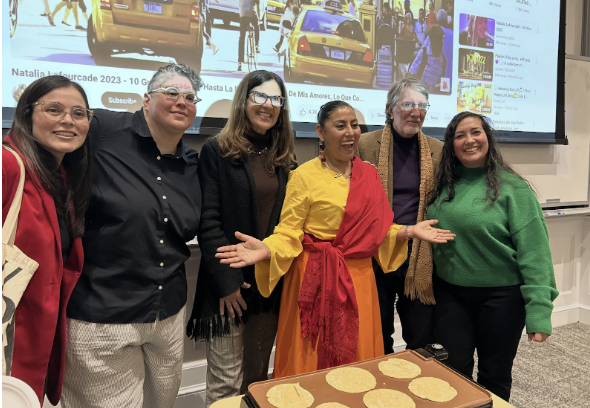
Photo: Tortilla workshop with Chef Cristina Martínez. Davidson College
We also invited Chef Cristina Martinez, an immigrant, migrant rights activist, and business owner. She led a tortilla workshop and a guest lecture on campus where faculty and students served as interpreters for the non-Spanish-speaking members of our community. This was a proud moment that blurred the line between the classroom and real-world application.
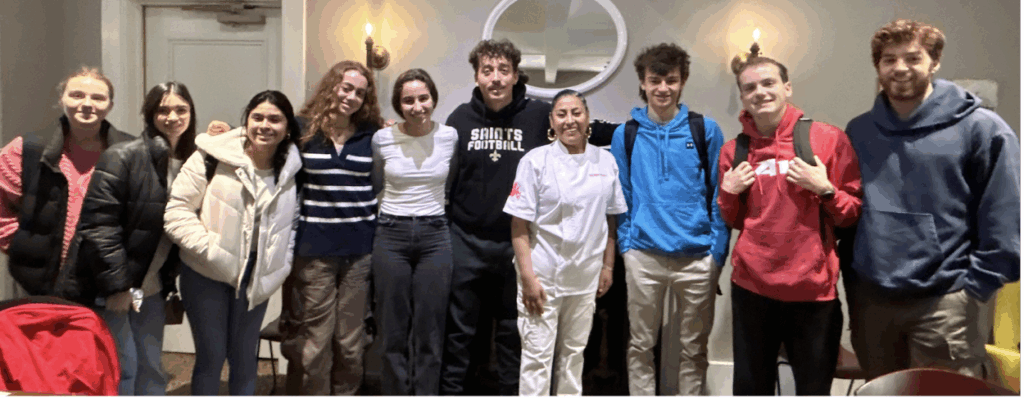
Photo: SPA 260 students at a guest lecture by Chef Cristina Martínez. Davidson College.
The second half of the semester focused on border and legal status issues, including DACA, Dreamers, asylum seekers, and unaccompanied minors. Our third guest speaker, Dr. Benjamin Roth (University of South Carolina), brought a research-based lens to these challenges. Students read and discussed one of his publications on college access for DACA students, then engaged with him in a moving and insightful conversation. A new student-led initiative to support immigrants was born after that conversation.
This set the stage for our final deliberation: “Immigration: Who should we welcome?” Once again, students grappled with questions of ethics and policy, but this time with greater confidence and depth. Through constructive dialogue, they not only practiced their Spanish skills but also formed thoughtful opinions about the values and considerations that should guide immigration policy.
A Transformative Experience
What began as an experiment in merging language instruction with deliberative practice evolved into something far more transformative. Through carefully scaffolded conversations about immigration and human rights, students not only strengthened their Spanish skills but also deepened their ability to think critically, form opinions, and engage empathetically with complex global issues.
- Our deliberations became fertile ground for intellectual growth, as students wrestled with ethical questions and explored diverse perspectives. One student shared, “The most meaningful part for me was the disagreements… everyone wanted different solutions and had different reasons for them.”
- Despite the different viewpoints, many found common ground and a sense of shared purpose. As one student expressed: “I have hope for my generation… we have different opinions but a similar goal: to bring people together.”
- Another recognized the layered nature of the issues at hand: “This deliberation reflected to me the interconnected nature of topics related to migration”.
- Perhaps most importantly, students left the course with a sense of agency. “This deliberation and this class gave me the ability to think and form opinions.
Language development went hand-in-hand with these critical conversations, as students became more confident speaking spontaneously, using authentic vocabulary and formulating nuanced arguments.
- One student said, “I felt more confident than in the first one and could express my ideas more clearly,” one student shared. Another noted, “The deliberation forced me to use words I hadn’t used much before.”
- Beyond vocabulary, students learned to think and react on the spot by listening actively and responding thoughtfully. “I had to think quickly in Spanish and explain my ideas clearly and with examples,” one student explained, while another shared, “I was more intentional with my words and improved my ability to speak concisely.”
By using Spanish to navigate real-world issues, students did not just practice speaking, they practiced empathy, perspective-taking, and democratic dialogue. I am deeply grateful to the DeeP Collaborative for helping me reimagine what language teaching can look like when civic engagement becomes a central goal.