The Deliberative Pedagogy (DeeP) Faculty Collaborative consists of faculty from Davidson College and other higher education institutions who are committed to learning and implementing new ways to improve and deepen the quality of their class discussions. These faculty come from a wide array of disciplines and backgrounds to study and discuss deliberative pedagogy methods, share their ideas and questions with one another, and work to embed deliberation in their classrooms. In this special blog series, members of the Collaborative describe and reflect on their experiences developing and teaching their deliberation-involved courses.
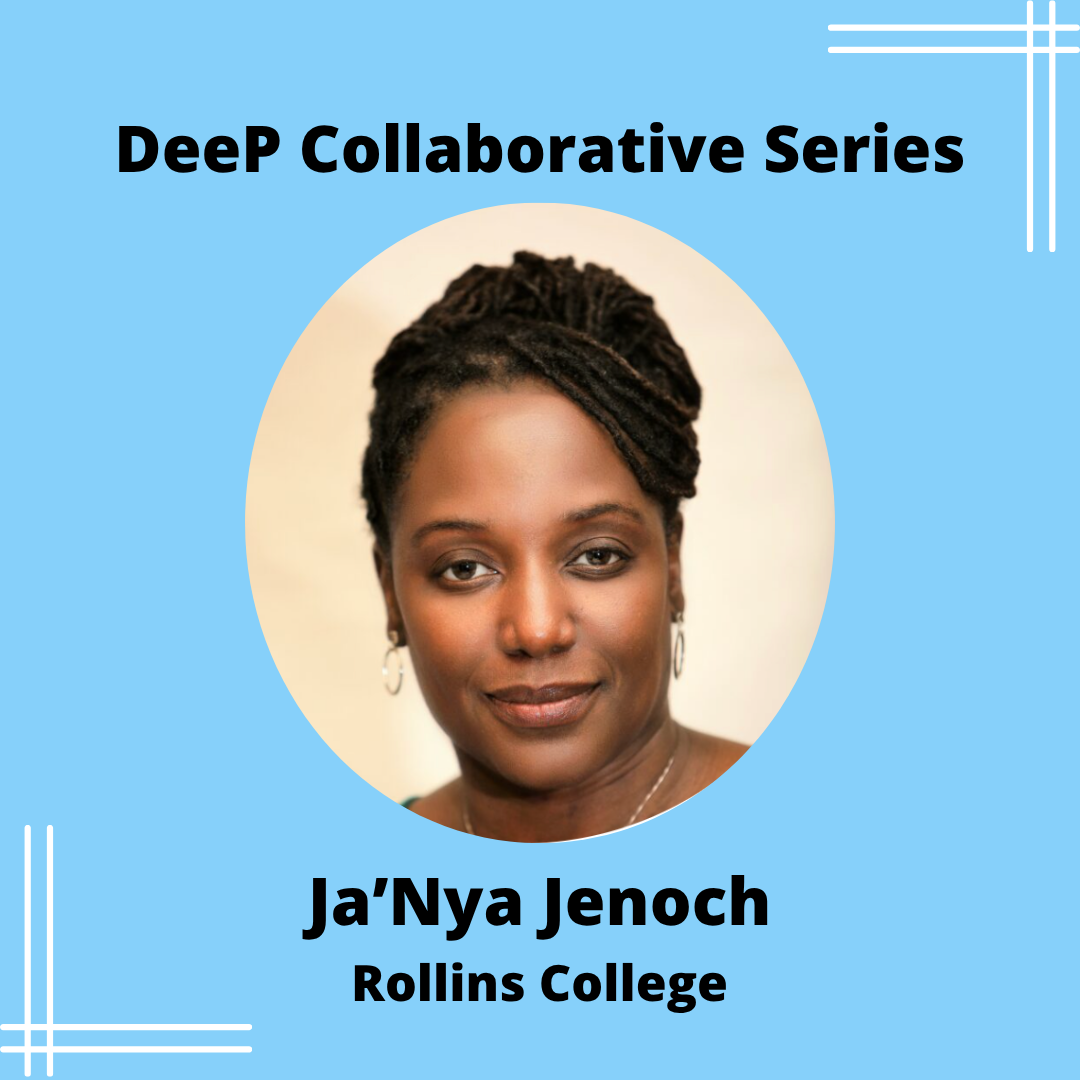
By Ja’Nya Jenoch (2024-25 Deliberative Pedagogy Collaborative Faculty Fellow)
The Process
When I first saw the email about applying for a Deliberative Collaborative Initiative (DCI) fellowship, I was intrigued and excited. As an early scholar, I enjoyed another teaching and learning fellowship two summers ago and it helped me to develop my teaching skills and increase confidence. So, I was curious to see what this DCI fellowship could bring.
The goal of the fellowship is for professors to develop and implement a deliberation-based syllabus in one course. I did not even know that deliberative pedagogy was a thing before reading that email; however, during our summer 2024 orientation my cohort and I were immersed in this innovative pedagogy for advancing civil conversations in the classroom. We not only learned what deliberative pedagogy was, we were supplied with ample tools and resources and sent back to our home colleges and universities with a 9-month plan for creating classes where students will be engaged in meaningful dialogue about our nation’s most pressing issues.
The Design
My pilot course for teaching deliberative pedagogy was a course about Black Americans—a topic that had been given a swift controversial/banned label after January 2025 by national leaders. It was being taught to upper-level sociology students at a private liberal arts college with full administrative support. My approach to the course was multi-fold and had the following goals:
- Provide a course that surveyed the topic using an historical lens.
- Introduce students to deliberative pedagogy through readings, observations, and practice.
- Have students present live class deliberations for their final course project.
- Maintain awareness of the impact of the political climate on course topics.
To give students the historical lens that I wanted them to include in their deliberations, we visited the college’s archives for a curated tour. The librarian shared with the students an
actual indenture document and they learned about the challenges with reading and interpreting writing from that time. They also left with lots of resources and instructions on how to find archival data.
Next students read some of the more popular literature on deliberative pedagogy such as chapters from the book, Why We Argue. Afterwards we discussed the readings and identified key elements of deliberative pedagogy. I also introduced students to other practices that are in the civil discourse arena. These included a Living Room Conversation about the course topic and a Civil Dialogue on the benefits and disadvantages of the Civil Rights Act. According to the hierarchy of types of discourses, I viewed each of these early activities as practice and preparation for deliberation.
Once students were immersed and more knowledgeable about civil discourse in general, in week five of the course they were required to attend one of the DCI online forums. They attended the forum on religion and enjoyed it tremendously. Students were asked to write a reflection about the forum in response to these four questions:
- Describe the facilitation styles that you observed and will plan to practice during your deliberation.
- Were there parts of the deliberation that were more helpful than the others (e.g., panel, deliberation, guide, etc.)? Explain why they were more helpful to you.
- What parts of the deliberation guide were most helpful in preparing you for the deliberation?
- What three things will you take away from the forum to create your own deliberation?
After the forum I led the class through an in-class deliberation. The topic was integration in Boston Public Schools in 1965, and we used a deliberation guide from the National Issues Forum website. The purpose of this deliberation was to provide a second model of a live deliberation. Students were tasked with identifying facilitator roles such as refereeing and weaving during this class deliberation. The deliberation guide also served as another example of what a guide should look like. The one that we used did an excellent job of outlining the three options for the topic.
The course ended with pairs of students leading the class in deliberations on topics of their choosing. In pairs they wrote deliberation guides that included archival data, standard deliberation guide requirements, and two to three options for their topic. During the deliberation class each partner in the pair led a small group of five students through an identical deliberation. Students were assessed jointly on their deliberation guide and separately on their deliberation practice as a facilitator. Their final assignment for the deliberation project was to write a brief reflection in response to two out of eight questions/prompts.
Results: Improved Engagement
After a year of learning about and implementing deliberative pedagogy, I would say that this is a teaching tool that I definitely plan to use many times in the future. I found that when students were informed about how we were going to engage in the classroom, when they were given a set of guidelines, when they were allowed to observe & experience what they’re being asked to do, they felt more confident engaging in the classroom and exploring new topics in unique ways. Remember that this was a class where almost half of the students were seniors. It was smaller than average and most of the students knew each other personally or from prior courses. I thought this helped the deliberation process to unfold with deeper connection to the material. However, I conducted a mini deliberation in an intro sociology course and the students were as engaged as the upper-level students.
Deliberation enabled quiet students to participate meaningfully and take on leadership roles.
Results: The Importance of Structure & Observation
Given that this was the first deliberation-focused class that I have ever taught, I was curious to see what fostered engagement in both upper and lower-level classes. What I noticed was that students connected well with the structure of deliberation. They liked reading conversation agreements and deliberative dispositions. I placed slides with these structured aspects of the deliberation on the screen and asked for students to volunteer reading a few statements out loud. The deliberation practice of outlining what was going to take place and for how long also helped students to feel anchored in this practice. When students knew what to expect, they were quick to align with the goals of deliberation.
In my upper-level course, I feel that having students attend the DCI’s online forum was a game changer. After attending the forum, students returned to class knowing exactly what deliberation looked and felt like. One student was excited that he got to be in a breakout room with real practitioners and was able to engage in conversation with them. I found the live forum attendance to be greatly beneficial to student learning. Another adaptation that made deliberation work well in this course was pairing students to complete the guide and then have them practice facilitation individually during class. I would use this format again
since during the guide preparation students can work together, bounce ideas of each other, and create a more comprehensive guide. During the class deliberation I could assess each person’s level of participation in creating the guide.
Results: Students’ Response
The responses from students were positive. They enjoyed delving into topics in a meaningful way. They liked the deliberations and reported that the class should be mandatory for all students due to how much they learned and the way that they learned. They also enjoyed choosing topics for their personal deliberations. Having a deliberation- style class also allowed us to include current topics related to our course in a seamless way. We were able to include current topics like the 2025 Superbowl halftime show, the impacts of hot-of-the-press executive orders, and other topics that were not on the syllabus, and still feel like we were on track with the course outline.
I was nervous at the start of the semester. This was because I did not know how comfortable students would feel discussing topics that were banned nationwide in many classrooms. Initially I noticed some hesitation to voice thoughts about topics relevant to Black America, however as the semester progressed students became more comfortable expressing their thoughts, feelings, and concerns about the course topic. We had some animated discussions and some where students stayed 10 to 15 minutes after class to continue discussions. By the time that students had to lead their own deliberations I was happy to observe a classroom of students who were fully in charge of their learning and engagement. That was a beautiful sight to see each time. Deliberation allowed students to focus on the art of engaging in civil interactions about difficult topics even in the middle of controversy.
Conclusion & Next Steps
Overall, the DCI experience was a positive one. I have learned a pedagogy that enlivened my classes and helped students form deeper connections with each other and with the course material. Some things I would change are that I would assign one key reading at the beginning instead of several chapters at once. This would give students an introduction and they could learn more through class discussion and lectures on deliberative pedagogy. I would also have them watch a deliberation from the DCI video archives before attending a live deliberation.
The ability to ask questions is a cornerstone of sociological inquiry. This was also true of deliberative pedagogy. When I was preparing mini-deliberations and giving students feedback on their deliberation guides, I found that asking key questions can make a deliberation spark active discussion or have it fall flat. Next time I will focus more time learning the art of asking questions to foster even better deliberations.
I plan to implement deliberation in a similar way into other upper-level classes. In the semester that I piloted deliberation in the one class, I ended up including mini deliberations in other classes and students mentioned in their course evaluations that they liked these activities and the class discussions that emerged. Deliberative pedagogy is an effective pedagogical practice. If the structure, questions, and setting are right, it can bring classroom discussions to life and make them full of meaning and candor.