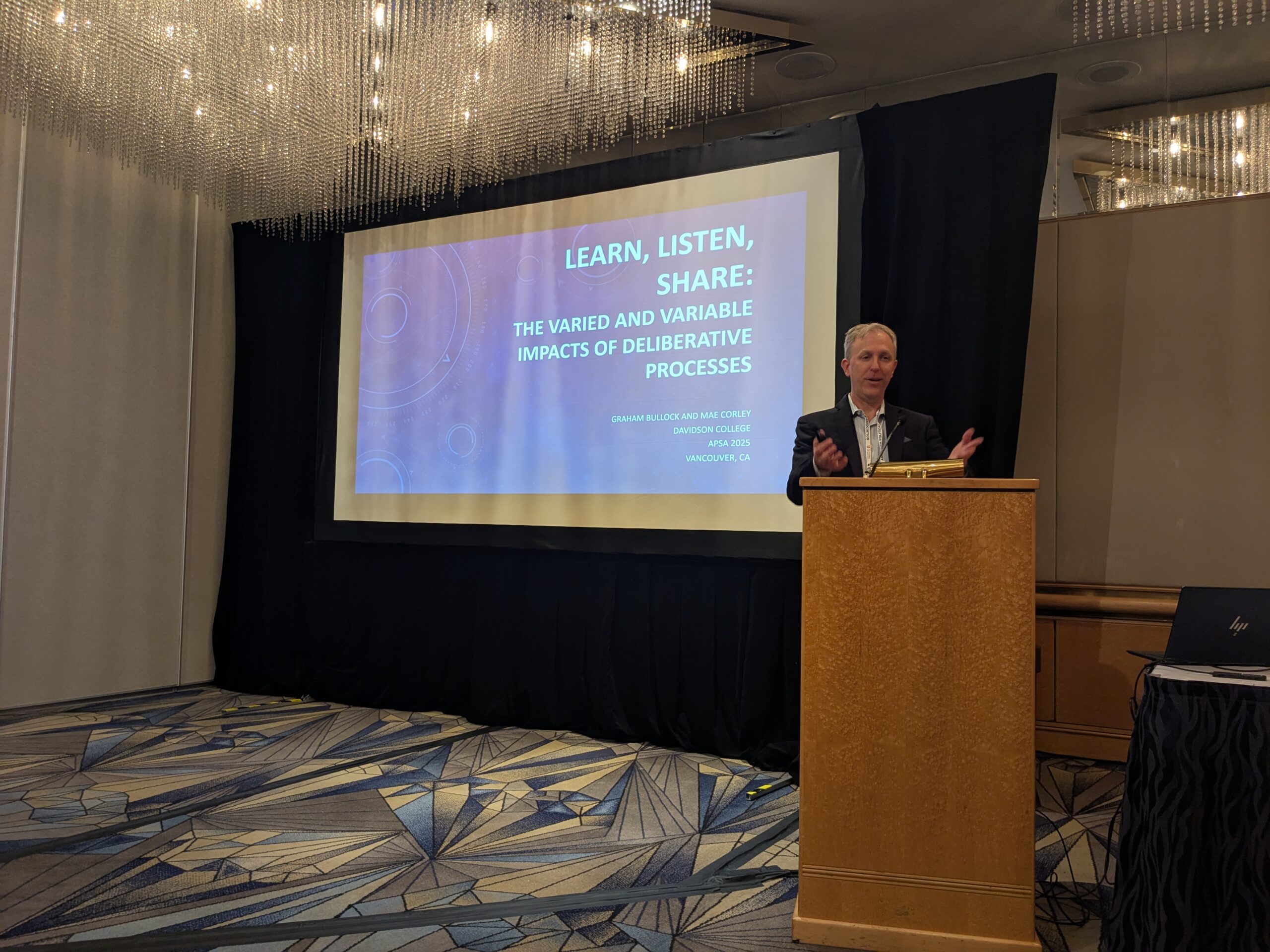
On September 11, 2025, DCI Faculty Director Graham Bullock presented a paper written in collaboration with Mae Corley ’25 on “Learn, Listen, Share: The Varied and Variable Impacts of Deliberative Processes” at the American Political Science Association (APSA) Annual Meeting in Vancouver, CA. The paper built on research conducted by Corley and Bullock in an independent study during the spring of 2025. Corley, who had served as a DCI Fellow, Senior Fellow, and Co-Convener as a student at Davidson, worked with Dr. Bullock on compiling and analyzing the pre- and post-survey data from 15 of the DCI’s Deliberative Forums.
This paper presents a comprehensive analysis of five years of data from forums that included both undergraduate students and community members. It examines the DCI’s forums as a structured communicative process designed to bring citizens together to discuss a wide range of global challenges. Topics explored in the forums covered by the paper included income and wealth disparities, climate change, religion in the public sphere, gun rights and regulations, the challenges for democracies, and more.
These deliberation-based forums rest on the idea that respectful dialogue can bridge divides and foster more considered opinions. But does this hold true for all participants? This paper examines the varied experiences of individuals who participated in this public discourse program, focusing on whether a participant’s identity—specifically their gender, race, age, and political ideology—shapes their perceptions of the forums they joined. Do participants with different backgrounds leave the forum with different perceptions and outcomes?
This question connects to a core theoretical tension in the literature. On the one hand, critical theorists suggest that participants from historically marginalized groups—such as non-white individuals, women, and young people—are likely to have less positive experiences in a deliberative setting than those from groups traditionally perceived as holding power. The fear is that dominant voices intentionally or unintentionally marginalize or silence others, leading to a less satisfying experience for some participants. Alternatively, those who believe these programs are intentionally and effectively designed to give disproportionate voice to the disempowered might assert the opposite effect. They would hypothesize that these groups will feel empowered and have more positive experiences than those who already hold significant power.
This paper uses survey data to explore these competing hypotheses. Its central research question is: How do a participant’s demographic characteristics, including gender, race, ideology, and age, correlate with their deliberative experiences and outcomes? The findings highlight the different types of impacts that deliberative processes can have and explore how these effects differ across topics and demographic groups. By focusing on how individuals engage with and interpret complex issues through deliberation, the study sheds light on the conditions under which public discourse fosters increased understanding, leads to shifts in attitudes and self-perceptions, and affects how participants engage with each other. It also explores how participants from different demographic backgrounds respond differently and similarly to the experience of engaging in deliberative processes.
Moreover, the analysis uncovers patterns of engagement that can inform strategies for enhancing the effectiveness of deliberative practices. The paper contributes to the field of political communication by offering empirical insights into the role of deliberation in enabling participants to engage with each other on complex social and political issues. By leveraging a sample of over 1400 participants who answered surveys before and after the hosted forums, it explores the potential and limits of deliberative processes to bridge divides, deepen understanding, and equip participants to engage with global threats. At the same time, it underscores the need to tailor these processes to the specific dynamics of the issues, audiences, and formats involved. These findings have implications for scholars and practitioners seeking to leverage public discourse as a tool for addressing the multifaceted challenges of our time.
Bullock and Corley will be incorporating the helpful feedback they received at the conference into their next version of the paper, which they hope to submit for publication soon. Stay tuned for updates!