If you are ready to register to attend the Expert Roundtable either in-person or online, click here. If you’d like to learn more first, read on below.
“We hold these truths to be self-evident, that all men are created equal…” (Declaration of Independence)
“We the People of the United States, in Order to form a more perfect Union…” (Preamble)
250 years ago next July, the Declaration of Independence, drafted by Thomas Jefferson and approved by the Second Continental Congress, formally separated the 13 colonies from British rule, placing the nascent country on the path to democracy. Beyond the Declaration’s grievances against the Crown or assertions about the nature of government, one line stands out in the collective memory of the American people: “We hold these truths to be self-evident, that all men are created equal.”
Those thirteen words and the doctrine of equality they promote have proven remarkably durable in American political culture. Referenced by the Seneca Falls Convention in its pleas for women’s rights, Abraham Lincoln in his Gettysburg Address, and Martin Luther King Jr. in his “I Have A Dream” speech, the foundational commitment to equality established in the Declaration has guided the country in some of its most pivotal moments. However, equality has never stood alone as the nation’s guiding value.
In 1787, as the US transitioned from the aspirational ideals of the Declaration to the practical governing framework of the Constitution, another value emerged as the Founding Fathers’ first priority: unity. They open the Constitution’s preamble not by echoing Jefferson’s emphasis on equality, but by anchoring the preamble in a sense of shared purpose through the words, “We the People of the United States, in Order to form a more perfect Union.”
After the 1786 Shays’ Rebellion exposed the weakness of the Articles of Confederation, the Constitution’s predecessor, Americans increasingly saw the need for a stronger framework to preserve the unity of the new republic. Since then, the importance of such unity would connect with many broader purposes and issues. As Abraham Lincoln’s famous line, “A house divided upon itself cannot stand,” suggests, a modicum of shared values that unites the country might be necessary for the American experiment to succeed.
This emphasis on unity, together with the Declaration’s statement about equality, represent the importance of considering both the nation’s egalitarian founding principles as well as its need to promote an enduring national identity. From the slavery debate to the New Deal to the failed adoption of the Equal Rights Amendment, the complementarities and conflicts between equality and unity have been a key feature of the American experiment. National unity fundamentally relies on recognizing and achieving equality and the inherent dignity of all individuals. However, the pursuit of equality – particularly policies addressing longstanding injustices and social disparities – can sometimes intensify societal divisions and challenge the existing sense of unity that holds the country together. Conversely, appeals to unity without adequately addressing existing inequalities risk perpetuating injustice and providing justifications for social unrest.
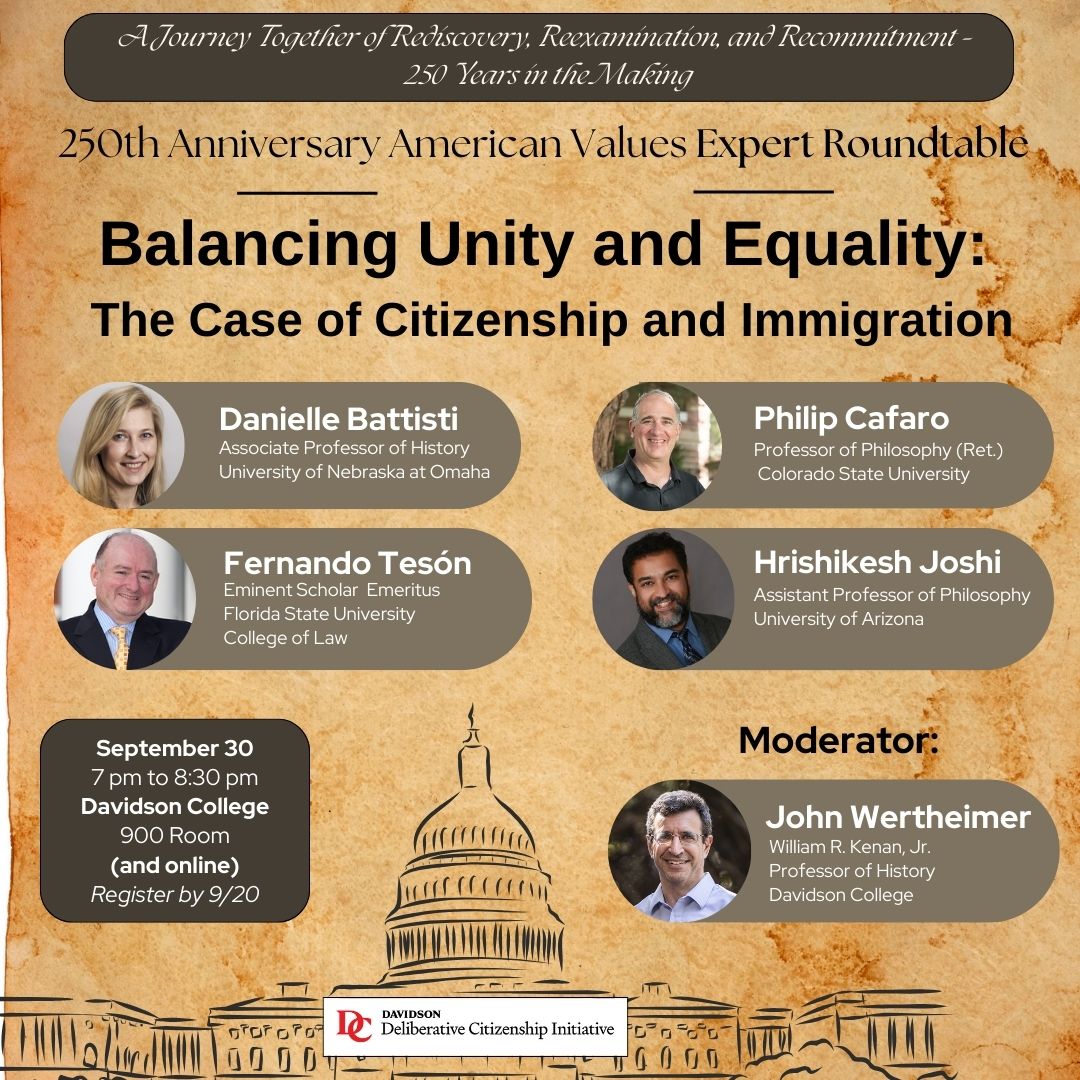
Davidson College’s Deliberative Citizenship Initiative is hosting an Expert Roundtable that will explore these dynamics both conceptually and historically. It will also explore how they are relevant to contemporary policy debates about immigration and citizenship, a domain where arguments about both unity and equality are frequently deployed from all sides of the political spectrum. The Roundtable will be held on September 30 from 7 to 8:30 pm in the 900 Room on the Davidson College campus, and it will also be broadcast live online. Register here to reserve a ticket today (deadline is 9/23).
The roundtable will include the scholars listed below, each of whom brings a unique set of expertise and knowledge to the conversation, both on the general questions related to unity and equality and on the specific topic of citizenship and immigration. Specifically, they will address the question, “How should immigration policies balance national cohesion with a commitment to the equal dignity of all people?”
Expert Roundtable
- Danielle Battisti is an associate professor of history at the University of Nebraska at Omaha where she specializes in immigration and ethnic history. Her book, “Whom We Shall Welcome: Italian Americans and Immigration Reform” (Fordham University Press, 2019) examines both the liberal and conservative elements of Italian American efforts to influence American immigration policies in the 1950s and 1960s. It was awarded the Immigration and Ethnic History Society’s best first book award for 2019. She is also the co-editor of Hidden Histories of Unauthorized Migrations from Europe to the United States (Illinois University Press 2025). One of her current projects is examining the immigration laws that largely facilitated Euro-Americans’ efforts to adjust their status from “illegal alien” to “legal permanent resident.”
- Philip Cafaro, a philosophy professor who recently retired from Colorado State, is the author of the book, How Many Is Too Many? The Progressive Argument for Reducing Immigration into the United States (University of Chicago Press, 2015), which argues that current immigration levels—the highest in U.S. history—undermine efforts to achieve a more economically just and ecologically sustainable society. He is also the co-editor of Life on the Brink: Environmentalists Confront Overpopulation (University of Georgia Press, 2012) and Virtue Ethics and the Environment (Springer-Verlag 2010) as well as the author of Thoreau’s Living Ethics: Walden and the Pursuit of Virtue (University of Georgia Press 2004) and “The Impact of Immigration Policy on Future US Population Size” in The Journal of Population and Sustainability (2025).
- Fernando Tesón is Eminent Scholar Emeritus at Florida State University College of Law. An Argentine-American legal scholar, he is a leading authority on humanitarian intervention and the philosophy of international law. He is the editor of The Theory of Self-Determination (Cambridge University Press 2016) and co-author of Debating Humanitarian Intervention: Should We Try to Save Strangers? (Oxford University Press (2017) and Justice at a Distance: Extending Freedom Globally (Cambridge University Press 2015). He has also published articles supporting less restrictive immigration policies, including “The Bourgeois Argument for Freer Immigration” in The Cambridge Handbook of Classical Liberal Thought and “Brain Drain” in the San Diego Law Review.
- Hrishikesh Joshi is an Assistant Professor of Philosophy at the University of Arizona, where he also serves as a core faculty member at the Center for the Philosophy of Freedom. His research focuses on normative issues at the intersection of philosophy, politics, and economics (PPE). He has published several chapters related to immigration and citizenship, including “Immigration Enforcement and Fairness to Would-Be Immigrants” (in The Handbook of Philosophy and Public Policy), “Immigration” (in The Routledge Companion to Libertarianism), and “Immigration: Some Arguments for Limits” (in The Routledge Handbook of the Ethics and Economics of Immigration). He has also published a book on Why It’s Okay to Speak Your Mind (Routledge).
John Wertheimer, the William R. Kenan, Jr. Professor of History at Davidson College, will serve as moderator of the roundtable discussion. Dr. Wertheimer’s research and teaching focuses on modern U.S. history and legal history; his two books – Law and Society in the South: A History of North Carolina Court Cases (University Press of Kentucky) and Race and the Law in South Carolina: From Slavery to Jim Crow (Amherst College Press) – explore the legal history of the U.S. South.
In the week following the Roundtable, the DCI will be hosting a series of Community Conversations that will build on the scholars’ deliberations. These two-hour deliberative discussions of 6-10 people will be moderated by trained facilitators and will use a similar format to the DCI’s D Teams. To learn more about this opportunity and reserve a spot at a time that works for you, click here (the deadline to do so is September 5). Duke, UNC, and potentially other institutions will be hosting similar conversations for their communities. If you are interested in hosting a conversation yourself at your organization, click here to learn more about a webinar we are hosting on how both individuals and institutions can get involved — and how the DCI can help you with doing so.
The Expert Roundtable and Community Conversation are both part of the Deliberative Forum Series on American Values that Davidson College, Duke University, and the University of North Carolina, Chapel Hill are co-hosting in the lead-up to the 250th anniversary of the Declaration of Independence and the nation’s founding. Approaching this milestone in an era marked by historical amnesia and selective memory, the series aims to foster a more complete understanding of our nation’s past and present. To learn more about and register for the other forums and community conversations that are a part of this series, visit this webpage for more information and updates.
Inviting participants to reflect on the foundational ideals that have shaped our republic, each of the four forums in the series will draw from both the Declaration and the Constitution’s Preamble to explore a pair of core American values that often complement each other but also have been – and remain – at the heart of deep tensions, particularly during moments of national change. Through dialogue grounded in history, informed by philosophical inquiry, and connected to current policy challenges, this series and this guide is designed to encourage thoughtful deliberation on how best to uphold and balance these enduring commitments in an ever-changing democracy.
Unity-Equality-and-Immigration-Roundtable-Poster