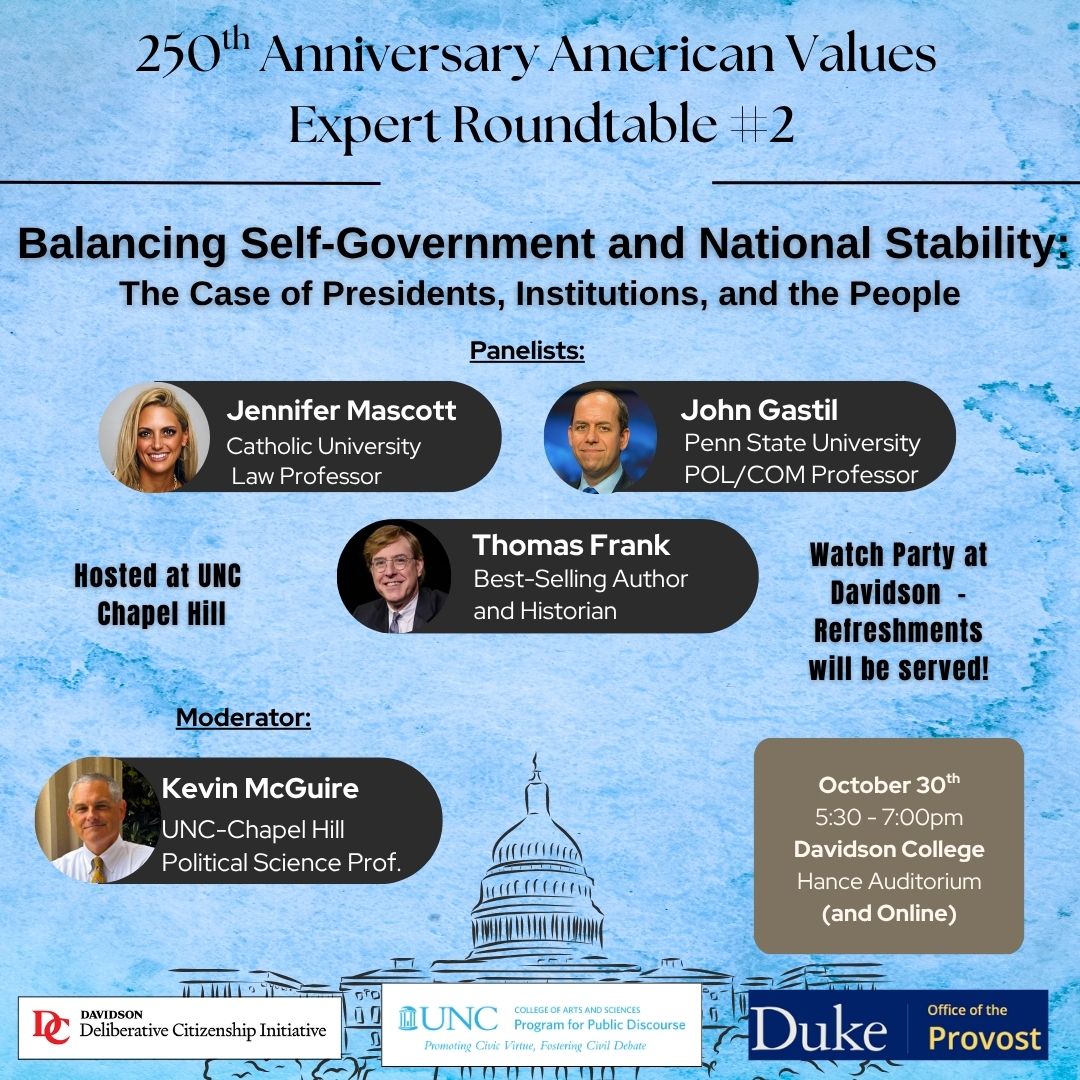
The Deliberative Citizenship Initiative invites you to join us for a watch party with Davidson students, faculty, staff, and community members in Hance Auditorium to view the second Expert Roundtable on “Balancing Self-Government and National Stability: The Case of Presidents, Institutions, and the People” that will be hosted at UNC Chapel Hill from 5:30 pm to 7 pm on October 30. Refreshments will be served. Registration is not required, but please help us out with our planning by clicking on this link. If you can’t join us in person, you can also view the Expert Roundtable online yourself by registering for the event via UNC Chapel Hill’s registration page.
The panelists on this roundtable include Thomas Frank (best-selling author of What’s the Matter with Kansas?), John Gastil (professor of communication studies, public policy, and political science at Penn State), and Jennifer Mascott (professor of law and founder of the Separation of Powers Institute at Catholic University). See below for more info about each panelist and the moderator (Kevin McGuire, UNC Chapel Hill professor of political science):
Thomas Frank is a historian and political analyst known for his critically acclaimed books, such as What’s the Matter with Kansas: How Conservatives Won the Heart of America (2004) and, most recently, The People, No: A Brief History of Anti-Populism (2020). Dr. Frank, who earned a PhD in history from the University of Chicago, is best known for his New York Times best-selling book, What’s the Matter with Kansas, while his more recent book on anti-populism explores the populism movements from the 1890s to the New Deal to the Civil Rights Movement to the present – and the resistance to them.
John Gastil is Distinguished Professor of Communication Studies, Public Policy, and Political Science at Penn State, where he also serves as Senior Scholar at the McCourtney Institute for Democracy and teaches courses on political communication, group behavior, and democratic deliberation. Dr. Gastil studies political deliberation and deliberative governance, and he has authored several books, including, most recently, Hope for Democracy: How Citizens Can Bring Reason Back into Politics (2019), which examines how the State of Oregon’s Citizens’ Initiative Review enables citizens and public officials to work together to bring more rationality and empathy into modern politics.
Jennifer Mascott is Associate Professor of Law (currently on public service leave) and the Founder of the Separation of Powers Institute at Catholic Law. Professor Mascott’s writing focuses on administrative and constitutional law, constitutional and statutory interpretation, and separation of powers in the U.S. context. Professor Mascott clerked for Supreme Court Justices Clarence Thomas and Brett Kavanaugh, served in the US Department of Justice in 2019 and 2020 and in the White House General Counsel’s Office in 2025. She was recently confirmed to serve on the US Court of Appeals for the 3rd Circuit.
Kevin McGuire is Professor of Political Science at the University of North Carolina at Chapel Hill and will serve as the moderator of the roundtable. Dr. McGuire teaches courses on the U.S. Supreme Court and American constitutional law. His current research interests include the effect of the Court’s institutional arrangements on the Court’s policymaking, the impact of public opinion on the Court, and the measurement and modeling of judicial outcomes. He is the author of Understanding the U.S. Supreme Court and The Supreme Court Bar: Legal Elites in the Washington Community , and co-editor of the forthcoming Creating Constitutional Change: Clashes over Power and Liberty in the Supreme Court .
250th Anniversary American Values Deliberative Forum Series
This event is the second Expert Roundtable in the 250th Anniversary American Values Deliberative Forum Series, which is designed to commemorate the upcoming 250th anniversary of the Declaration of Independence. This anniversary represents an important opportunity to both deepen and elevate the discourse about the values that have animated American social and political debates throughout its history. The goal of the series is to enable Americans of all backgrounds – college students, high school students, families and neighbors, members of faith communities and other civic organizations – to authentically, respectfully, and constructively engage with each other about our foundational ideals and how they are relevant to contemporary policy issues.
Co-hosted by Davidson College’s Deliberative Citizenship Initiative (DCI), Duke University’s Provost’s Initiative on Pluralism, Free Inquiry, and Belonging, and the University of North Carolina at Chapel Hill’s Program for Public Discourse, this year-long program will include both Expert Roundtables and Community Conversations dedicated to unpacking, understanding, and applying the values that are foundational to the United States – and to many other countries around the world.
Watch Parties and Community Conversations
This year, we’re proud to partner with two other North Carolina institutions of higher education, Duke and UNC Chapel Hill, to expand the reach of the series. Davidson will host two of the Expert Roundtables, while Duke and UNC will each host one roundtable on their respective campuses. All four will be available to watch online, with potential for “watch parties” to be held at higher education institutions and other organizations across North Carolina and beyond, including Davidson, Duke, and UNC-Chapel Hill.
Organizations can also host Community Conversations in the week after the Expert Roundtable. For ideas on how to host either a watch party of community conversation, check out the webinar that DCI Faculty Director Graham Bullock hosted that provides an overview of different strategies and options you might work well in different organizational and community contexts. Please email dci@davidson.edu if you have any questions or ideas you’d like to share.
Below are some guides that you can use to host such conversations. The Deliberation Guide provides both important background information on the topics in question and a specific framework for engaging with these topics in the context of a two-hour facilitated conversation, which is the format that the DCI’s D Teams will use to explore the topic. The Issue Guide is similar to the Deliberation Guide but does not include the structured format for group conversations. The Issue Brief provides a brief outline of the main ideas that are presented in the Deliberation Guide and Issue Guide. While both include a similar list of questions to consider about the topic, they are designed for personal reflection before, during, or after our expert roundtable on the same topic.
ISSUE BRIEF
ISSUE GUIDE
DELIBERATION GUIDE
Expert-Roundtable-on-Presidents-Institutions-and-the-People