• Skip to main content
  • Skip to footer

Deliberative Citizenship Initiative

Building Democracy One Conversation at a Time

  • The Initiative
    • Programs
      • Deliberation Across the Curriculum
      • Deliberation on Campus
      • Deliberation in the Community
      • Research on Deliberation
    • Motivations
      • Why Deliberative Citizenship?
      • Why Davidson? Why Now?
    • Who’s Involved?
      • DCI Fellows Cohorts
        • 2025-2026 Fellows
        • 2024-2025 Fellows
        • 2023-2024 Fellows
        • 2022-2023 Fellows
        • 2021-2022 Fellows
        • 2020-2021 Fellows
      • DeeP Collaborative Cohorts
        • 2024-2025 DeeP Collaborative Faculty
        • 2023-2024 DeeP Collaborative Faculty
      • Advisory Council
    • History
      • What Sparked the Initiative?
    • Key Deliberative Dispositions
    • Frequently Asked Questions (FAQ)
    • Annual Report
  • Get Involved!
    • Participate in a Forum
    • Join a D Team
    • Become a Fellow
    • Take Courses
    • Get Training
    • Come to Guest Lectures
  • Events
    • Upcoming Events
      • 250th Anniversary Deliberative Forum Series on American Values
    • Past Events
  • Connections
    • The Deliberative Citizen: The DCI’s Monthly Newsletter
    • Efforts on Campus
    • Efforts in the Community
    • Efforts Elsewhere
    • Readings and Resources
      • DCI-Published Guides
      • DCI Guide to One-on-One Conversations
      • How to Disagree
      • Demonstration of Facilitation Styles
      • Deliberative Pedagogy Mini-Course
    • How We Can Help: DCI’s LET’S DELIBERATE! Partnership Opportunities
    • DCI in the News
  • DCI Blog Posts
    • Recent Blog Posts
    • All Blog Posts

Archives for August 2026

We Tried to Fix Jubilee’s “Middle Ground” – Here’s How It Went

August 27, 2026 by Graham Bullock

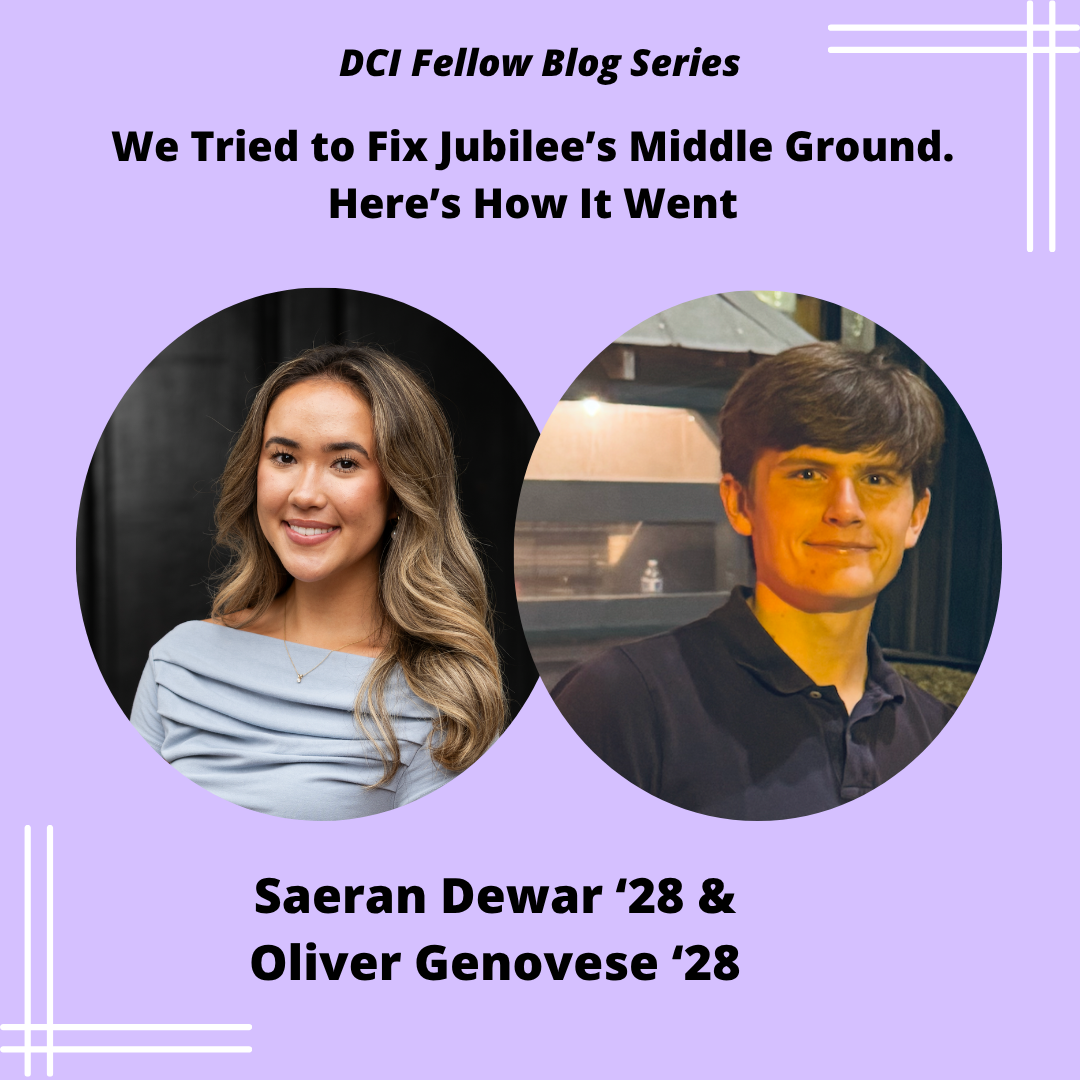
photos of Saeran and Oliver

By DCI Fellows Saeran Dewar ‘28 and Oliver Genovese ‘28

The “Middle Ground” Model

Jubilee’s Middle Ground series has garnered millions of views online. Jubilee is a digital media company that brings people from various backgrounds together to film content to post online, generally with the ethos of encouraging empathy in uncomfortable situations. Middle Ground, one of their most viral formats, has three people on two sides of a controversial issue step forward to a circle of chairs if they agree with a given statement, with the disagreers eventually joining the circle to discuss.

You may have seen this video they did on Trump supporters vs immigrants on the immigration issue. On their website, Jubilee writes, “Middle Ground explores whether two different groups of people, opposed in their beliefs, can come together empathetically and find middle ground.” However, we noticed that the structure of the conversation itself is not conducive to participants engaging empathetically or finding the middle ground featured in the title of the series.

We thought it would be a great idea to bring the same concept to Davidson to promote more robust deliberation within the Middle Ground model. In our case, we chose to have a deliberative dialogue on immigration. Some problems that we noticed, though, with typical Jubilee Middle Ground videos are that participants often do not engage with each other respectfully, instead making hasty generalizations and assuming ill intentions on the part of their opponents.

In order to create a more robust conversation that aligns with the DCI’s deliberative principles, we selected participants from across the political spectrum who are generally politically active on campus. By doing so, we were able to facilitate a better conversation that did not put any participants at a disadvantage. We will not reveal our deliberators’ identity in order to maintain their anonymity, only referring to them by their preferred ideological labels. 

What We Changed

To address the flaws we saw in the original Jubilee format, we implemented several changes to make the process more deliberative. First, we read DCI’s Conversation Agreements at the beginning of the discussion. While this was a minor change, clearly stating expectations at the outset so participants knew what kind of engagement was expected of them, and what they could expect from others, helped set the tone for the event. Agreements such as “assume the best – and not the worst – about the intentions and values of others” as well as “avoid speaking in absolutes” are often absent from Jubilee discussions.

Second, we implemented a beginning section with a chance for introductions and casual conversation. They got to share a bit of background about themselves and engage in small talk before the real substance of the discussion began. Entering a deliberation where you know you are going to encounter vastly different opinions than your own can be intimidating, but seeing non-politicized sides of people helped deliberators humanize each other beforehand.

Additionally, Davidson being a small environment, the deliberators had already mostly interacted with each other on some level and were not strangers. We thought putting strangers in a room together who know nothing about each other could hinder their inclinations to be charitable to one another.

Also, Saeran served as a facilitator throughout the discussion. Many Jubilee videos lack a facilitator, meaning that all participants have to engage in a dog fight for airtime. As facilitator, Saeran posed questions to the group, chose when to invite disagreers into the circle and invited those who had not spoken in a while into the conversation, keeping participation as even as possible and making sure everyone was heard.

Lastly, and perhaps most significantly, the discussion was held in a private space and was not filmed. Because participants were able to engage in the deliberation in a more low-stakes fashion, they were more likely to agree to participate as well as be candid with their contributions and fearlessly engage with others’ perspectives as well.

How It Went

Although he was not originally supposed to participate as a deliberator, due to unforeseen circumstances causing one participant being unable to attend, Oliver ended up joining the Jubilee discussion. The discussion from the start involved both sides crossing partisan lines, including a neo-conservative and a liberal student, both disagreeing with the statement that all Americans are immigrants.

While the six deliberators crossed party lines numerous times to agree with the other side on a statement, a key party-line disagreement came with the following statement: “Having a massive influx of immigrants into the United States erodes American culture.” The conservative students argued over the threat of non-Western cultures, such as non-Christian beliefs, eroding the culture of the United States. On the other hand, liberal students argued that the “melting pot” nature of American culture and the diversity within it is a key strength of the United States, and thus all cultures should be welcomed.

The conservatives emphasized specific rules associated with Islam that they believed could undermine American democracy, such as a woman’s testimony in court accounting for only half of a man’s. Some conservative students emphasized the Christian founding of the US and that an influx of other cultures would disrupt the nation. The liberal students argued that those choosing to come to the US do so because they want to improve their lived circumstances and thereby contribute positively to the US. The disagreement over the statement ended with both sides accepting that there were differences in opinion on the impact of welcoming non-Western cultures on American values and society.

Overall, the deliberation itself was more respectful and engaging than those in Jubilee Middle Ground videos online. At times in Jubilee videos, participants are more apprehensive and seem to only listen to get their point out and respond, but in our deliberation project, the participants seemed to listen thoughtfully and find points of agreement. Not only did the participants seem to actively listen, but due to their knowledge about current political events, the arguments were mostly fact-based, which helped foster a more robust dialogue that revolved around the argument itself rather than attacking other people’s character.

Reflection

If we were to run another mock Jubilee discussion, we would want to allow more time for the event. Realistically, it is difficult to ask student volunteers to devote more than an hour and a half of their time on any given day, but at least two hours would make a big difference for the depth of discussion deliberators are able to have and the disagreements they are able to dig into. Saeran had to cut off a fascinating conversation on the question of the erosion of American culture due to time constraints, but she would’ve loved to see that discussion go on longer.

Additionally, the diversity of viewpoints represented on the right-leaning side was not exactly mirrored on the left-leaning side, which was slightly more homogenous. We could not have precisely anticipated each participant’s precise political leanings beforehand, but more viewpoint diversity on the left might have made for a more enriching experience.

Overall, the process of planning our mock Jubilee “Middle Ground” was a great experience, and hearing the deliberators engage with each other head-on was fascinating and incredibly encouraging to see them deliberate so thoughtfully, respectfully, and boldly.
Filed Under: Fellow Posts

A Case for Deliberation in the Natural Sciences

August 27, 2026 by Candice Thomas

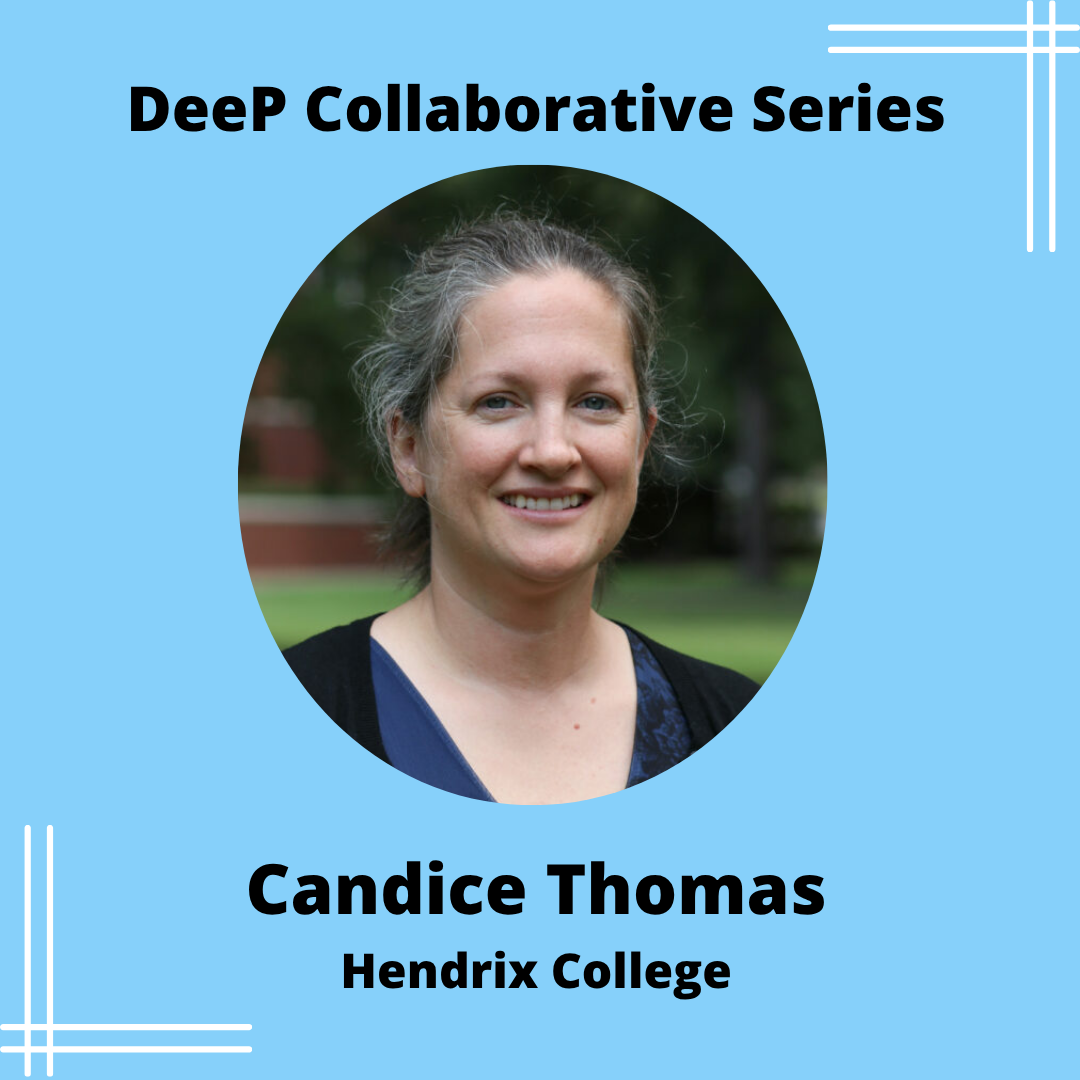
Photo of Candice Thomas

The Deliberative Pedagogy (DeeP) Faculty Collaborative consists of faculty from Davidson College and other higher education institutions who are committed to learning and implementing new ways to improve and deepen the quality of their class discussions. These faculty come from a wide array of disciplines and backgrounds to study and discuss deliberative pedagogy methods, share their ideas and questions with one another, and work to embed deliberation in their classrooms. In this special blog series, members of the Collaborative describe and reflect on their experiences developing and teaching their deliberation-involved courses.

By Candice Thomas (2024-25 Deliberative Pedagogy Collaborative Faculty Fellow)

As a natural scientist, deliberation wasn’t initially on my radar as something to integrate into my courses. I primarily teach Human Anatomy and Physiology (A&P) and Nutrition courses, and I tend to approach those topics as a platform to inform others about how the body works (A&P) and how to nourish it (Nutrition). I didn’t think that there was much room for discussion in these courses because, in my mind, I just present the facts.

It didn’t take long for me to discover that I might need to reconsider. In my Nutrition course, the idea of adding deliberation as a meaningful approach to difficult topics presented itself when we started to move into more controversial topics such as food deserts and sustainability. I initially approached these topics as I had any other, just present the facts, but then one brave student raised their hand and added their own lived experience into the discussion. Soon, others weighed in and a whole spectrum of unique lived experiences and perspectives presented themselves.

It became apparent very quickly that I would need to allow time for more meaningful discussions in my courses that do not fit neatly into the framework of what is presented in a textbook. I really enjoyed these initial discussions, but I wasn’t certain how to navigate them. I didn’t know how to ensure that every voice was heard, and the environment felt safe and productive for each student in the room. So, when I learned about the DeeP Collaborative, I finally saw a path forward in which I could introduce discourse into the classroom setting in a meaningful and productive way.

Equipped with a roadmap for how to incorporate deliberation into the classroom, I headed into a course that was new to me, Senior Seminar for Health Sciences, this past spring semester. This course serves as the capstone course for all our Health Science students and is a last stop summative experience before they graduate. I saw this as an opportunity to really help our students navigate difficult conversations in a productive way before they left the safety of the college to enter into the real world.

By its very nature, careers in healthcare require that providers interact with a diverse population of patients, caretakers, and others each with their own unique perspective based on lived experiences and background. It isn’t a far stretch to imagine that any of those interactions may be challenging to navigate. Sometimes, I feel that when students graduate, we are throwing them into the fire and hopeful that they will just figure things out without any real guardrails or tools in place to help them with these specific challenges around discourse.

I viewed this course as an opportunity to empower students to think creatively and listen empathetically and truly connect with their future cliental. Ultimately, I decided to introduce controversial topics into the Health Sciences Senior Seminar course and to use deliberation to allow students to express, defend, and consider diverse perspectives in a formal way. My goal was that students could take this experience with them into the next step on their journey and appreciate that they don’t have to agree with everything that everyone says or does, but it is important to be respectful of others and consider their stories. I believe this to be a very important piece of the puzzle in healthcare.

The capstone course had several requirements built in that were not possible to alter as these assignments are required for program assessment. However, I was pleasantly surprised at the ways that I could use the course objectives and projects that were already in place to integrate deliberation into the course. For example, students are required to use published literature in their field of study to write a paper. In preparation, students read several primary literature articles and come to class prepared to discuss them with the instructor and their peers. Students are also required to prepare a presentation based on primary literature, journal club style, walking their peers through the article and fielding questions about the paper.

I decided to use these activities and assignments to have students present a perspective and support it with evidence in the form of peer reviewed primary literature. This served as the expertise on the topic. In addition, I asked students to create a deliberation guide on the topic they presented. As a class, the students selected three controversial topics in healthcare that they were most interested in exploring further.  Students then ranked the topics in order of the topic they were most interested in presenting to the topic they were least interested in. 

There were 18 students in the course, and with three general topics, I was able to split the class up into three groups of six. For each topic, one group of six students was assigned to be the presenters and moderators on their deliberation day (“the organizers”); the other 12 students would serve as participants (“the deliberators”) in the deliberation. The six student “organizers” for a topic were randomly assigned a “side” to defend such that three students would present and defend one side, and the other three students would present and defend the other side.  One group presented one day and the next group presented the following day. These six students then created a comprehensive deliberation guide as a group project and distributed them to the 12 student deliberators for that topic.

On the deliberation day, the student organizers who presented and created the deliberation guides served as deliberation moderators in one way or another, either as the facilitator, devil’s advocate, or rule enforcer. By deliberation day, the deliberating students were to have read two papers, one in favor of a “side” and the other in favor of the other “side,” and the organizing students’ deliberation guide. At the deliberation they were randomly assigned to one of two groups as participants (just to limit the size of the deliberation). Each group needed to come up with a policy that they could all agree on by the end of the deliberation. Each student then completed a reflection. Then for the next topic, the next group of six (six different students) served as facilitators and the process repeated twice.

In the deliberations, the deliberating students came into the deliberation with their own lived experiences, beliefs and values; they were not assigned a position or side. The weeks that preceded this portion of the course were spent learning about deliberation, the creation of deliberation guides and deliberation day rules, and participation in a practice deliberation that I facilitated so that student facilitators were prepared to do it themselves. I did not participate in the deliberations myself and was therefore able to observe and take notes on what I heard and saw to provide insight before the next deliberation and adjust as necessary for future sections.

What I learned is that students really enjoyed participating in deliberations. They enjoyed the formal structure and the fact that there was some oversight by the facilitators that created a safe space to share. Students were able to realize the value of this activity and how it could help them approach difficult conversations in the future. I also enjoyed this aspect of my course; it was very different from what I am used to doing and caused me to step outside of my comfort zone and try something very different. As an educator it is important for me to challenge myself, not be afraid to try new things, and model that for my students.

There were a few areas for improvement as well. It is critical that students come to the deliberations prepared. I found that student participants weren’t reading the papers that were presented on each topic by the facilitators, so they weren’t able to expand much upon what the literature stated, making some of the discussion a bit generic. The unprepared students would often just agree with what someone else already contributed but didn’t add to the conversation. I also found that trying to integrate three deliberations into the course was a bit much. The students and I could benefit from taking a bit more time on the background of deliberation and the importance of it. 

I will continue to incorporate deliberation into my courses but with a few changes. The first change that I will make is to slow down and reduce the number of formal deliberations that we do. I will spend more time on the background of deliberations and work through a couple of example case studies. I have also decided to integrate controversial topics into their final capstone paper in a way that the students have a more vested interest in the deliberation process. Finally, to ensure that students read the literature and engage more with the subject matter, I will have all students reflect on each article and contribute to the creation of a collaborative deliberation guide.

 I am now teaching the second section of the Senior Seminar in which I will implement these changes for a more improved experience with deliberation for my students. I have learned from speaking with students in this new class that some of them have even chosen to sign up for this section of the course so that they can participate in the deliberative process. I find this to be a promising step in the right direction, and I am honored to be part of that process.

Filed Under: Faculty Posts

Footer

Blog Post Categories

  • Announcements
  • Blog Posts
  • DCI Posts
  • Events
  • Faculty Posts
  • Fellow Posts
Image of a compass superimposed by the text "Deliberative Citizenship Initiative" and "Davidson College." Clicking on this image leads to the Initiative page.

Recent DCI Blog Posts

  • We Tried to Fix Jubilee’s “Middle Ground” – Here’s How It Went
  • A Case for Deliberation in the Natural Sciences
  • Welcoming New Staff to the DCI and DCN
  • Facebook
  • Twitter
  • Instagram
  • LinkedIn


Copyright © 2026 · Infinity Pro on Genesis Framework · WordPress · Log in